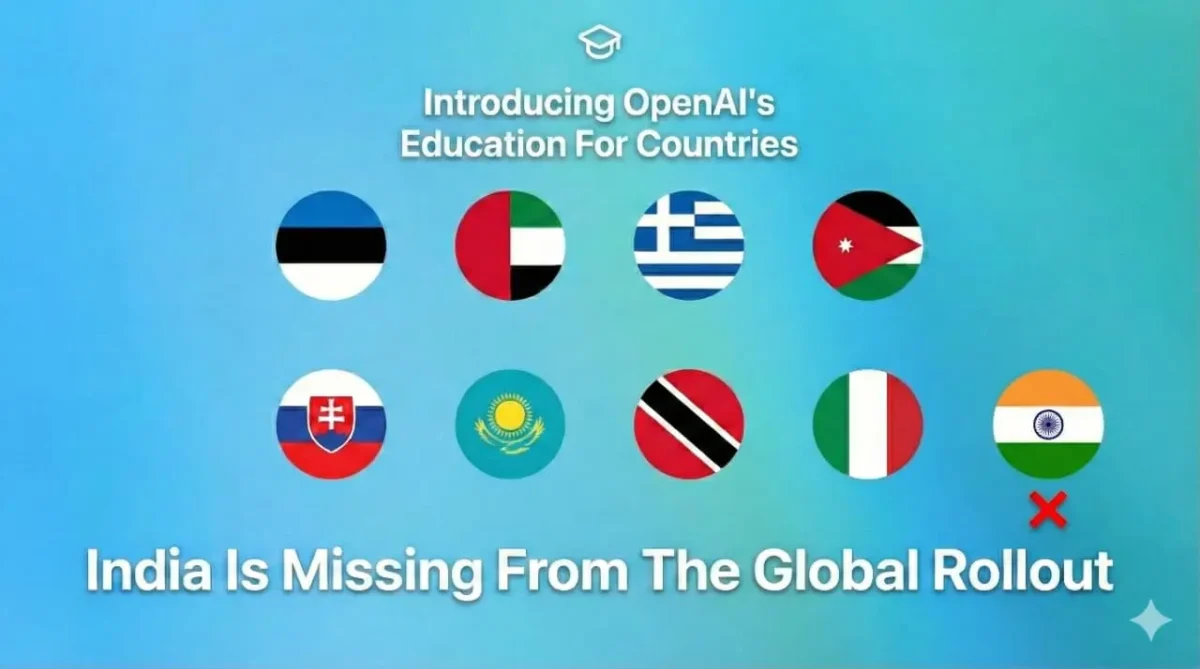
India has the world’s largest student population and one of the fastest-growing AI ecosystems. Yet when OpenAI announced its biggest global education initiative, India was not on the list.
The program, called Education for Nations, is designed to help governments modernise education systems by using AI at the national level. Countries like Estonia, Greece, Italy, Jordan, Kazakhstan, Slovakia, Trinidad and Tobago and the United Arab Emirates are already part of the first group. But India’s absence stands out. The program, called Education for Countries, is designed to help governments modernise education systems using AI at a national level. Countries like Estonia, Greece, Italy, Jordan, Kazakhstan, Slovakia, Trinidad and Tobago, and the United Arab Emirates are already part of the first cohort. But India’s absence stands out.
Given India’s scale, talent base, and push toward digital and AI-led growth, the question feels unavoidable: why hasn’t OpenAI launched this program in India yet?
So What Exactly Is OpenAI Offering to Countries?
Education for Countries is not a consumer product launch. It is a system-level partnership designed to work with governments, education ministries, and university networks.
This initiative focuses on four main areas. First, it offers AI tools for learning, including ChatGPT Edu, advanced AI models, study mode, and collaborative workspaces that can be customised according to local preferences. Second, it supports large-scale research to measure how AI impacts learning outcomes and teacher productivity. Third, it provides certification and training aligned with national workforce goals. Ultimately, it creates a global network where countries share insights and best practices on responsible AI use in education.
In short, this is not about giving students another app. It is about embedding AI into the core infrastructure of education systems.
Why Countries Like Estonia Can Move Faster Than India
One key reason India is not in the first cohort comes down to speed and coordination.
Smaller countries like Estonia and the UAE have centralized education systems and fewer regulatory layers. Decisions can be made quickly, pilots can be launched across the country, and results can be studied in a controlled manner. For example, Estonia has already deployed ChatGPET Edu in public universities and secondary schools, reaching thousands of students and teachers.
India’s education system is far more complex. It spans central boards, state boards, private institutions, public universities, and multiple ministries. Rolling out AI at a national level requires alignment across many stakeholders, which naturally takes time.
For OpenAI, the early cohorts are about learning through controlled pilots, not chasing scale immediately.
This Isn’t a Tech Problem. It’s a Policy and Trust Problem.
Technology is not the main barrier. Policy and trust are.
Education systems handle minors, sensitive student data, and long-term academic records. Countries in the first group already have clear national AI frameworks or existing partnerships around data protection and responsible AI use in education.
India is still deciding how foreign AI models should work inside public systems, especially when it comes to data governance, accountability and long-term controls. Unless those guardrails are clearly defined, a nationwide rollout would be risky for both OpenAI and Indian institutions.
From OpenAI’s side, launching without strong policy alignment could damage trust. From India’s side, moving too fast could create dependencies without enough local oversight.
India Is Not a “Pilot Country”
India is not just another market in a global rollout. It is potentially the largest education deployment in the world.
That scale changes everything. A pilot in Estonia affects thousands of users. One pilot can impact millions of people in India. Infrastructure preparation, regional language support, curriculum alignment, teacher training and cost structures have all become far more demanding.far more demanding.
OpenAI’s current approach emphasizes phased adoption, starting with teachers and then gradually expanding to students. In India, even a “small” pilot would be big by global standards. That reality alone is enough to push India into the latter group.
Being Late Might Actually Work in India’s Favour
Interestingly, India’s absence from the first cohort may not be a disadvantage.
By the time India gets on board, OpenAI will have real-world data on learning outcomes, clear safety models for young users, proven training frameworks for teachers, and strong certification pathways linked to jobs. India could avoid the initial experiment and adopt a more mature, battle-tested version of the program.
Given India’s focus on employability, skill development, and workforce readiness, this timing could actually lead to better alignment with national goals.
When India Joins, It Won’t Look Like Anyone Else
When Education for Nations eventually launches in India, it is unlikely to be a replica of what exists in Estonia or Greece. It will need to be integrated with national education policies, regional languages, vocational training systems and large public institutions.
OpenAI has said that new groups will be announced later in 2026. India’s absence today does not indicate rejection. This indicates complexity.
AI in education is not about moving fast for headlines. It is about responsibility, trust, and long-term impact. For a country like India, getting it right matters far more than getting it early.
And when it does arrive, it may shape one of the largest AI-powered education transformations in the world.