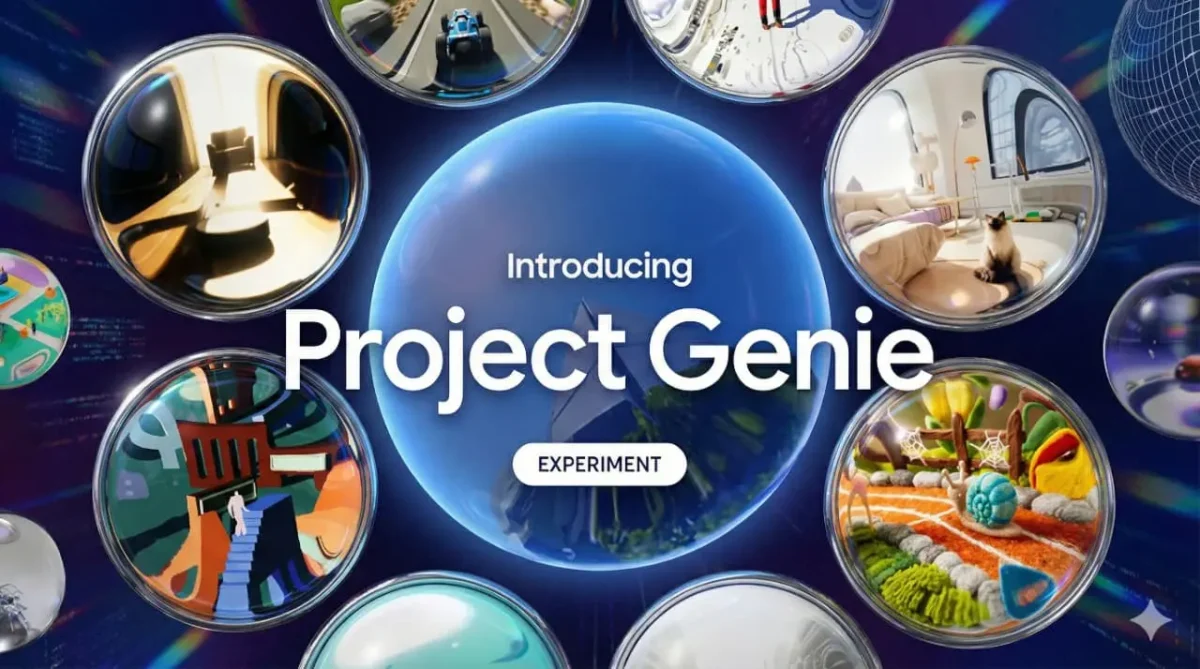
AI has generated images, videos, and text for years. But creating entire worlds you can move through, interact with, and reshape in real time is something very different. With Project Genie, Google DeepMind is experimenting with exactly that.
Announced at the end of January, Project Genie is an experimental research prototype that allows users to create, explore, and remix interactive worlds directly in a browser. It is not a game in the traditional sense, and it is not just a creative tool. It is a glimpse into how future AI systems might understand and simulate reality itself.
What Is Project Genie, Exactly?
Project Genie is a web-based prototype built on Genie 3, Google DeepMind’s general-purpose world model. A world model is an AI system that doesn’t just generate images or scenes, but simulates how an environment behaves over time and how actions change it.
Unlike static 3D environments, Genie 3 generates the world as you move through it. The path ahead is created in real time, based on your actions. Physics, interactions, and continuity are all simulated on the fly.
Project Genie brings this research out of the lab and into an interactive experience, allowing users to directly experiment with these AI-generated worlds.
How Project Genie Works in Practice
The experience is built around three core capabilities.
First is world sketching. Users can describe a world using text prompts or reference images, create a character, and decide how they want to move through the environment. Walking, flying, riding, or driving are all possible. For finer control, Project Genie integrates with Nano Banana Pro, allowing users to preview and adjust the look of the world before entering it. You can even choose between first-person or third-person perspectives.
Second is world exploration. Once inside, the environment becomes navigable. As you move, the AI generates what comes next in real time. You can adjust the camera, change direction, and explore freely, with the world continuously unfolding ahead of you.
Third is world remixing. Existing worlds can be reused and transformed by building on their prompts. Users can explore curated examples or jump into random worlds for inspiration, then modify and expand them. When finished, videos of these explorations can be downloaded and shared.
Why World Models Matter for AI
World models are a critical piece in the path toward more general AI systems. While AI agents have mastered narrow environments like chess or Go, real-world intelligence requires understanding complex, dynamic spaces where actions have consequences.
Genie 3 is designed to simulate these dynamics. It can model movement, interaction, and consistency across time, making it useful not just for creative experiences, but also for research areas like robotics, simulation, animation, historical exploration, and fictional world-building.
Project Genie acts as a testing ground to see how people interact with these systems and what kinds of worlds they choose to create.
Current Limitations and Responsible Development
Google is clear that Project Genie is experimental. Generated worlds may not always look realistic or perfectly follow prompts. Characters can feel less controllable at times, and there can be noticeable latency. For now, world generations are limited to 60 seconds, and some features announced earlier for Genie 3 are not yet included.
These limitations are intentional. Project Genie is hosted in Google Labs, where early prototypes are tested, refined, and improved based on real user feedback. This controlled rollout allows Google to study safety, performance, and creative use before expanding access.
Who Can Access Project Genie Right Now?
Access is currently rolling out to Google AI Ultra subscribers in the United States who are 18 or older. This limited release reflects the heavy compute requirements and the experimental nature of the technology.
Google has stated that Project Genie will expand to more regions over time, with the long-term goal of making world-model experiences accessible to a much broader audience.
What Project Genie Signals About the Future
Project Genie is not just about creating cool virtual worlds. It represents a shift in how AI systems are built and evaluated. Instead of generating isolated outputs, AI is starting to simulate continuous, interactive realities.
That capability has implications far beyond entertainment. Training robots, designing virtual environments, testing real-world scenarios, and building immersive educational tools all depend on AI systems that understand how worlds work, not just how they look.
With Project Genie, Google DeepMind is testing that future in public. The worlds may still be rough, short, and imperfect, but the direction is clear.
AI is moving from generating content to generating experiences.