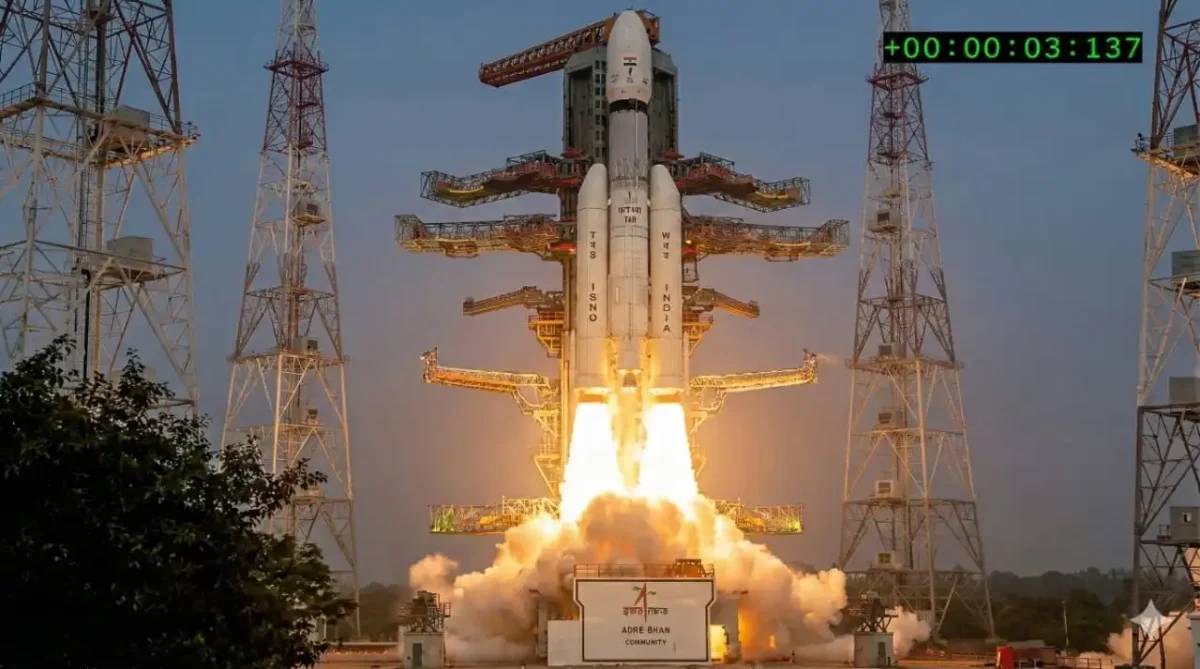
India’s space story is often told through big scientific missions, moon landings, and national pride moments. But sometimes, the most important shifts happen quietly, without drama. One such moment came late in December when an Indian rocket lifted a massive satellite into space for a private foreign company. That single event says a lot about how India’s role in the global space economy is changing.
On December 24, ISRO’s heavy-lift LVM3 rocket launched AST SpaceMobile’s BlueBird Block-2 satellite from Sriharikota. The satellite weighed around 6,100 kilograms, making it the heaviest satellite ever launched from Indian soil using an Indian launcher. With this mission, ISRO commercial launch capability entered a new phase, not in theory, but in real-world execution.
What made this launch different was not just the weight. It was the purpose. This was not a scientific experiment or a government communication satellite. It was a commercial mission for a US-based company that wants to change how mobile phones connect to networks.
AST SpaceMobile is building satellites designed to connect directly to normal smartphones, without special hardware or ground towers. Their BlueBird satellites unfold in space to reveal huge antennas, some of the largest ever deployed in low Earth orbit. Launching something this large requires trust, precision, and proven engineering. That trust was placed in India, and that is where the real importance of this ISRO commercial launch lies.
Why this launch matters beyond the rocket
For decades, ISRO focused mainly on national missions. Commercial launches existed, but they were limited in scale. This mission shows that India is now ready to handle high-value, high-risk international contracts. It was executed through NewSpace India Limited, ISRO’s commercial arm, which was created to bring business discipline into India’s space programme.
This launch was not about publicity. It was about reliability. In the commercial space market, companies choose launch providers who can deliver on time, safely, and repeatedly. A successful ISRO commercial launch sends a strong signal to other satellite operators watching closely.
The LVM3 rocket itself played a crucial role. With its solid boosters, liquid core stage, and cryogenic upper stage, it is India’s most powerful launcher. Until recently, it was used mainly for flagship missions like Chandrayaan and Gaganyaan test flights. Now, it is proving its value as a commercial workhorse. That transition is essential if India wants a steady share of the global launch market.
There is also a clear economic angle. Commercial launches bring revenue that can be reinvested into future technologies. NSIL has already reported strong growth, and heavy-lift missions like this one sit at the top end of the revenue scale. Each successful ISRO commercial launch improves India’s credibility as a cost-effective but reliable alternative to Western launch providers.
Globally, the space industry is becoming crowded. Companies like SpaceX are racing ahead with massive satellite constellations. Others are experimenting with different designs and business models. AST SpaceMobile has chosen a path that relies on fewer but much larger satellites. Supporting such missions places India directly in the middle of next-generation space-based communication systems.
This mission also strengthens India’s strategic independence. The engines, guidance systems, cryogenic technology, and launch infrastructure are all developed domestically. That means India controls its timelines, pricing, and priorities. It also means fewer external dependencies, which is critical in a world where space is becoming a strategic domain.
Looking ahead, AST plans to launch dozens more satellites over the next two years. Some will fly on American rockets, others may return to India. Every successful ISRO commercial launch increases the chance that more international companies will choose Indian rockets for their missions.
What this launch ultimately shows is maturity. Not flashy ambition, but quiet confidence. A rocket lifted off, a satellite deployed correctly, and control was handed over smoothly. In commercial space, that is the highest standard.
India is no longer just participating in the global space economy. With missions like this, ISRO commercial launch services are becoming a serious option for the world. And that shift may prove more impactful in the long run than any single headline-grabbing mission.